Credit Scoring with ML Inference at Play
Play, a telecom company with 13 million customers, runs credit scoring in Nussknacker and deploys its Python ML models from MLflow without developer involvement.
- Industry
- Telecommunications
- Services
- wireless voice, messaging, and mobile internet
Modernizing Credit Scoring Through ML Integration: A Play Telecom Case Study
Play, a telecom company with 13 million customers, implemented Nussknacker for their credit scoring system.
Nussknacker enabled the integration of MLflow into the credit decisioning process, allowing Python-based machine learning models to be deployed without developer involvement.
Model inference was decoupled from the initial application, allowing data scientists to work in Python while storing models in MLflow.
Domain experts and business analysts could directly modify ML models within Nussknacker (used to calculate scoring and other business rules), reducing reliance on technical teams.
The post Telecom’s credit scoring system with ML inference describes the architecture and the rules in detail, and the ML model inference page covers the feature itself.

Business Context
Telecommunications companies face inherent risks when offering phones on installment plans and service contracts. These risks include:
Credit risk from customers unable to meet payment obligations
Fraud risk from individuals signing contracts with no intention to pay
Requirement to adjust credit scoring models based on evolving customer behavior and the increasing sophistication of fraudsters who devise new methods to bypass security measures
Initial Challenges
ML Model Integration Barriers
The original credit scoring system was a component of a fairly monolithic application, which created several operational challenges:
Model updates required developer intervention, leading to slow iteration cycles
Pre-processing and post-processing logic was tightly coupled within the system
Model deployment to production was complex and time-consuming
Integration of new models required significant development time
Limitations of Business Logic Changes
The system's structure contained frequently changing business logic which was maintained by developers:
Domain-specific business rules were difficult for developers to understand and implement
Credit risk analysts couldn't directly manage or modify business logic
Frequent rule changes required detailed specifications and developer involvement
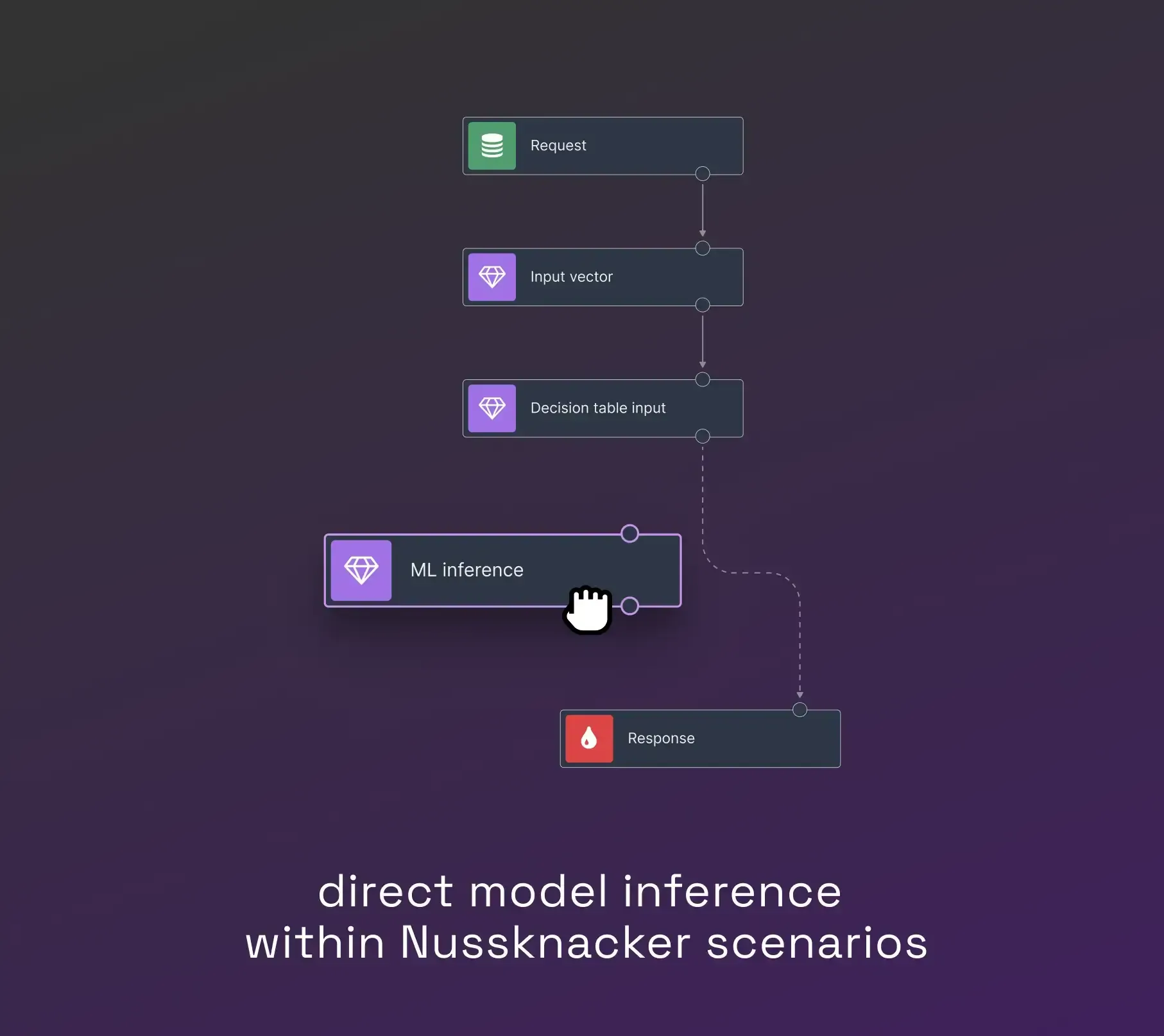
Direct ML model inference within Nussknacker
Implemented solution combines MLflow model registry with Nussknacker's ML runtime. This integration enabled seamless deployment of Python-based machine learning models without requiring developer intervention.
Process Transformation
The new system architecture separated model inference from the core application, allowing data scientists to work in their preferred Python environment while storing models in MLflow.
Domain experts gained the ability to modify models and versions directly through Nussknacker's interface.
Business Logic Migration
Play moved frequently changing business rules into Nussknacker scenarios, enabling business analysts to manage decision algorithms directly. This included rules for customer eligibility, calculate deposit amount, or determining whether customer needs to provide additional documents to prove their identity.
Real-time ML Technical Architecture
The new system architecture includes Nussknacker with several key components:
SQL enrichers for accessing pre-calculated features
Real-time feature computation capabilities
Decision tables for channel-specific parameters
ML enrichers for model inference
Flexible response preparation and handling
Results
The implementation of Nussknacker's platform delivered several key improvements:
Operational Efficiency
Faster model deployment and updates
Streamlined business rule modifications
Reduced technical bottlenecks
Team Empowerment
Data scientists can build models using familiar Python tools and gained autonomy in model development
Business analysts could directly manage decision logic
Reduced dependency on development teams
Technical Benefits
Flexible MLflow integration for model registry and versioning
Simplified architecture
Enhanced monitoring capabilities
Real-time feature computation and decision automation
Future Capabilities
The new system positions Play for continued innovation in credit risk assessment. The platform's flexibility allows for gradual rollout of new models, with capabilities for A/B testing and external service integration.
Are You Scoring Credit Fast Enough?
Take control of your credit risk strategy and unlock the power of real-time ML inference with Nussknacker's low-code decisioning platform. Contact us to start building smarter, faster scoring flows today.